
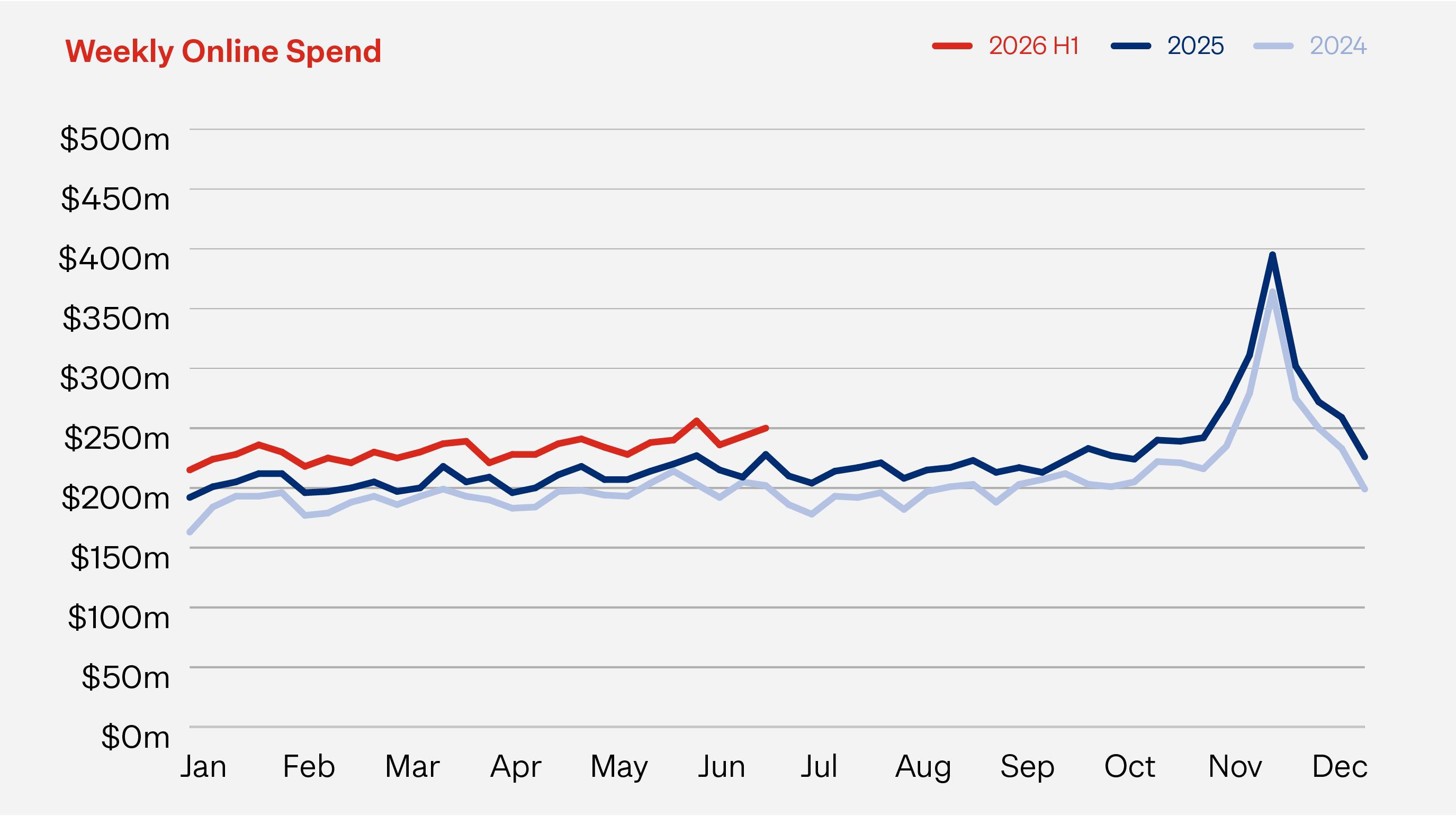
The first half of 2026 (H1 2026) is showing us the early signs of a retail recovery. Online spending in the first half of 2026 was up 12% compared to the same period in 2025, driven by a 10% increase in online transactions and a 1% rise in the average basket value. This steady growth is being driven by increased shopping frequency rather than rising prices, suggesting improving consumer confidence, a pick-up in discretionary spending, and growing momentum leading into year-end Peak.
H1 2026 Summary takeaways
- Online retail is growing six times faster than instore.
- Growth is transaction volume‑driven, not just inflation‑led.
- Domestic retailers continue to win share, growing spending faster than international retailers to capture 79% of all online spend.
- Online spending grew across all sectors, driven by transaction growth in both essential and discretionary categories.
- Older shoppers are rapidly expanding their online presence.
- Regional and provincial growth continues to outpace urban growth.
The numbers behind the growth
The first half of 2026 continues the volume‑driven online growth we’ve seen over recent years. Compared with the same period two years ago, when households were navigating cost-of-living pressures, the first half of 2026 saw shoppers make over seven million additional online transactions. Emerging from one of the toughest retail environments in living memory, online retail transaction appears to have now become woven into everyday life.
Online spending rose 12% year‑on‑year – six times faster than instore growth – with growth coming from more transactions, not just larger baskets. The number of online transactions increased 10%, while the average basket size edged up 1%. That means Kiwis are buying online more frequently, across a wider range of categories, rather than simply spending more per order.
This combination of rising transaction frequency and stable basket sizes points to a confident but considered shopper: one who turns to online channels for both everyday essentials like groceries and beauty products, as well as the occasional higher‑value homeware and lifestyle purchase.
H1 2026 Online snapshot (growth vs H1/25)
Spending $6b++12% | Transactions 50m++10% | Average basket size $120+1% |
At the same time, physical retail continues to grow but at a significantly slower rate – up just 2% in H1/26 compared to a year earlier. While instore still represents nearly 80% of total retail, online’s share of total spending continues to rise steadily, reinforcing it as the primary engine for New Zealand’s retail growth. Another interesting point is the growing basket size gap, with the average online basket ($120) now more than double the instore basket ($54). It appears shoppers are shifting more and more of their share of wallet online.
H1 2026 Instore Growth (vs H1/25)
Spending + 2% | Transactions + 1% | Average basket size + 2% |
This balanced, volume led growth supports a healthier long term model for retailers. Frequent, smaller online purchases help maintain cashflow and deepen engagement, while gradual improvements in basket value enhance profitability and customer lifetime value.
HELPFUL HINT FROM NZ POST
Think frequency, not just value. Encourage repeat purchases and loyalty through subscriptions, reordering options and targeted offers. Regular, lower-value sales often deliver more stable revenue than chasing one off high value orders. Couple this with delivery consistency and repeat purchases will be the enabler of your bottom-line.
Domestic vs International: Local retailers strengthen their lead
Nearly 80% of all online spending in H1/26 was with New Zealand based retailers. This has continued to rise over the last few years, confirming that Kiwi shoppers prefer buying local. Domestic online spending rose 13% year on year, 4 percentage points higher than offshore retailers. Local transactions grew by 11%, while international transactions grew by 9%. And the gap in basket sizes also widened, with the average domestic basket now a massive $55 greater than the international basket.
H1 2026 Domestic vs international online spend (vs H1 2025)
Domestic share of 79% | Domestic spending growth + 13% | International spending growth + 9% |
Domestic vs International + 23% | Domestic average basket size $137 | International average basket size $82 |
This growth reinforces the ‘buy local’ trend we’ve seen consistently over the last two years. Our Market Sentiments 2026 Report shopper research highlights speed and reliability; trust and transparency; and supporting local communities, as the three main drivers of this behaviour.
Where offshore platforms compete on price and product range, domestic retailers win on trust, speed and connection. As shoppers regain confidence, local retailers should capture a disproportionate share of growth, reinforcing that delivery experience, trust and local presence have become competitive advantages.
HELPFUL HINT FROM NZ POST
Leverage your Kiwi advantage. Make ‘local’ visible through your marketing and delivery experience. Highlight your local physical presence, trusted fulfilment partners, transparent order tracking and simple return options. Reinforce the sense that buying from you means buying confidently, close to home. We explore this local advantage – including more ways to capitalise on it – in our Market Sentiments 2026 Report.
Sector summaries: Essential + discretionary growth
Online spending increased across all retail sectors in H1/26, though growth rates varied widely. The mix of results reflects a retail landscape advancing at different speeds, with everyday categories continuing their steady climb while discretionary sectors rebounded more sharply. Groceries, Specialty Food and Liquor remained the largest online category, now firmly embedded in Kiwi households’ regular shopping routines. Meanwhile, Clothing & Footwear and Health & Beauty delivered strong growth, suggesting shoppers continue to prioritise personal and lifestyle spending despite broader retail caution. Together, these categories underline how ecommerce is serving shoppers’ practical and lifestyle needs.
H1 2026 vs H1 2025 Clothing & Footwear (21% online market share)
Spending growth + 16% | Transaction growth + 12% | Basket size growth + 4% |
- Domestic online spending +15%; International online spending +16%
- Instore spending +1%
H1 2026 vs H1 2025 Department, Variety & Misc. Retail (24% online market share)
Spending growth + 16% | Transaction growth + 25% | Basket size growth - 8% |
- Domestic online spending +15%; International online spending +20%
- Instore spending +3%
H1 2026 vs H1 2025 Health & Beauty (2% online market share)
Spending growth + 32% | Transaction growth + 31% | Basket size growth + 1% |
- Domestic online spending +34%; International online spending +9%
- Instore spending +16%
H1 2026 vs H1 2025 Homeware, Appliances & Electronics (9% online market share)
Spending growth + 18% | Transaction growth + 17% | Basket size growth + 1% |
- Domestic online spending +17%; International online spending +22%
- Instore spending +4%
H1 2026 vs H1 2025 Recreation, Entertainment, Books & Stationery (18% online market share)
Spending growth + 3% | Transaction growth 0% | Basket size growth + 4% |
- Domestic online spending +8%; International online spending -3%
- Instore spending +1%
H1 2026 vs H1 2025 Specialty, Food & Liquor (24% online market share)
Spending growth + 9% | Transaction growth + 7% | Basket size growth + 2% |
- Domestic online spending +9%; International online spending +5%
- Instore spending +2%
HELPFUL HINT FROM NZ POST
Deliver what shoppers value in your category. Every sector is at a different stage of maturity, but each offers opportunities to stand out through the things shoppers value most. Our Market Sentiments 2026 Report shows shoppers increasingly define ‘value’ as more than just price – they’re looking for quality, reliability, authenticity, and a sense of local craftsmanship. Focus on these strengths to drive trust, loyalty and revenue.
Changing shopper demographics: a broader landscape
Online retail continues to reach across generations in 2026. While younger digital natives remain most active online, the growth story is increasingly being driven by older consumers.
- The 65+ age group recorded the highest spending growth of around 18% compared to H1/25, driven almost entirely by higher transaction volumes as they become more comfortable navigating the convenience of online platforms. This group values ease, transparency and reliability, factors highlighted in the Market Sentiments 2026 Report as major drivers of trust.
- The 35-44 segment accounted for around 27% of all online spending, maintaining their position as the single largest online shopping group. Balancing busy family lives, this group relies on online shopping for both convenience and value, purchasing across a wide range of categories. They remain the core engine of online growth.
Together, these trends illustrate an ecommerce landscape that is becoming broader, more inclusive and more ingrained in daily life.
HELPFUL HINT FROM NZ POST
Design for every life stage. Make the shopping experience easy for older customers while keeping it fast and mobile friendly for younger ones. Offer multiple payment and contact options, clear returns policy details, and real time delivery updates to meet the expectations of more mature shoppers while maintaining ease for digital natives.
Regional highlights
Online spending grew in all regions in H1 2026 but growth rates varied, with provincial centres continuing to grow faster than the major cities. This continues to highlight ecommerce's ability to defy geographic constraints, enabling retailers to access customers well beyond their traditional catchment areas.
- Auckland online spending – which accounted for 31% of the country’s total online spend in H1 2026 – was up 12%, driven by a 11% increase in transactions.
- The fastest rates for online spending growth, compared to a year earlier, were in Tasman (+17%), Taranaki and Northland (+15%).
- The lowest growth rates for online spending were in Nelson (+7%), Marlborough (+9%) and Wellington (+9%).
HELPFUL HINT FROM NZ POST
Expand regionally with reliable partners. Use partners that have nationwide reach to deliver wherever your customers are. Reliability and transparency remain key trust builders for regional shoppers. Ensure your delivery partners have flexible delivery options to reduce rural friction, allowing shoppers to balance speed and price.
Looking ahead: Cautious optimism leading into Peak
The first half of 2026 ended on an encouraging note for the New Zealand economy, with several key indicators and sentiment trending upwards. The latest GDP numbers1 saw the economy grow by 0.8% in the March 2026 quarter, exceeding expectations and easing fears of a prolonged downturn. Combined with gradually improving employment data and an easing in fuel prices, confidence is rebuilding after an uncertain start to the year.
The lull in Middle East tensions pushed business confidence up in June, as many firms began to see improved trading conditions and better than expected domestic demand. Consumer sentiment is also improving: the latest ANZ Roy Morgan Consumer Confidence Index2 rose to its highest point in nearly two years, reflecting a slight easing in inflationary pressure, reduced mortgage repayments and a slightly brighter personal outlook.
Yet this recovery remains fragile. With the general election still too close to call, uncertainty continues to weigh on both households and businesses. Retailers face an unpredictable six months as they plan for Peak with volatile global markets impacting logistics costs, and inflation expectations remain unclear.
The overall picture heading into the second half of 2026 is one of cautious optimism. While the economic momentum is real, confidence needs more nurturing. For retailers, that means focusing less on predicting the external environment and more on controlling the fundamentals that drive sales conversion. If H1 2026 was defined by rising purchase frequency, Peak 2026 is likely to be won by retailers who convert that frequency into loyalty and repeat purchasing rather than relying solely on discount-led acquisition.
In the quarter ahead, we encourage retailers to focus on:
- Building on confidence. Use the improving mood to re engage your customer base, highlight value, reliability, and the ‘feel good’ factor of buying local. Consumers are willing to spend, but they remain highly discerning.
- Investing in fulfilment and delivery readiness. 97% of shoppers who are satisfied with the delivery experience are more likely to repurchase from the same store.3 With growth returning and spending frequency and size rising, a reliable delivery experience will matter more than price competitiveness alone.
- Driving discoverability. As shoppers look around for value, being found is more crucial than ever. Check both your SEO and AI discoverability. (We provide some good tips on how to be found by AI in our latest Market Sentiments 2026 Report.)
- Building resilience into supply chains. The global situation remains uncertain, so secure inventory early and develop contingency options with logistics partners to reduce the impact of Peak bottlenecks or price hikes.
- Doubling down on trust and transparency. With scams and misinformation on the rise, visible authenticity matters. Clear communication around product origin, returns, and delivery builds loyalty across generations.
The first half of 2026 saw the start of the shift from recovery to growth. Kiwi consumers are shopping online more often, spending across a broader range of categories, and increasingly choosing local retailers. For retailers preparing for Peak, the opportunity isn't simply to capture demand, but to convert returning confidence into long-term customer relationships. Those who deliver consistent value, an excellent website-to-doorstep experience and local connection are the ones most likely to translate this renewed optimism into a strong finish to 2026.
About our new data methodology. We're continuing to review and evolve our data methodology to ensure we deliver the most complete picture of New Zealand's online shopping landscape. This edition of eSpotlight features a new approach using a variety of credible sources, moving beyond our previous reliance solely on card transaction data. Data was compiled and provided by leading data analysis firm, Dot Loves Data.
As online shopping has evolved, we've expanded our data collection to include payments made through mobile apps, digital wallets, and other payment platforms that better reflect how Kiwi shoppers purchase today. To maintain accuracy in our comparisons, this new methodology has been applied retrospectively to previous periods, ensuring all information is presented on a like-for-like basis.
We've also extended our analysis to provide more detailed sector category data, delivering more granular insights for retailers. As the eCommerce environment continues to evolve, we remain committed to refining our approach to capture the full spectrum of online shopping activity and deliver the most valuable insights for New Zealand retailers.
This report is published for general information purposes only. The views and opinions expressed, and any advice provided, is general in nature only. NZ Post does not represent that any information or advice it contains is suitable for your circumstances or purposes.
1 https://www.rnz.co.nz/news/business/598572/economy-grows-as-gdp-rises-0-point-8-percent-in-march-quarter
2 https://www.roymorgan.com/findings/10272-anz-roy-morgan-nz-consumer-confidence-june-2026
3 Study: NZ Post Receiver Monitor, May 2026