
Every year, the final quarter (Q4) – from Labour Weekend through to year end – is the most important trading period for most retailers. Kiwi shopper habits have continued to evolve with the economic conditions of recent years, and Peak 2025 was no exception.
Peak 2025 (Q4 2025) delivered strong overall growth, with online spending up 11% on Q4 2024 while in-store spending grew by a more modest 2%. Households continued to manage the cost-of-living pressure, in one of the toughest retail environments in recent years, by directing more of their spend online. Online increased its share of retail spending from just over one in five dollars in Q4 2024 to almost one in four in Q4 2025.
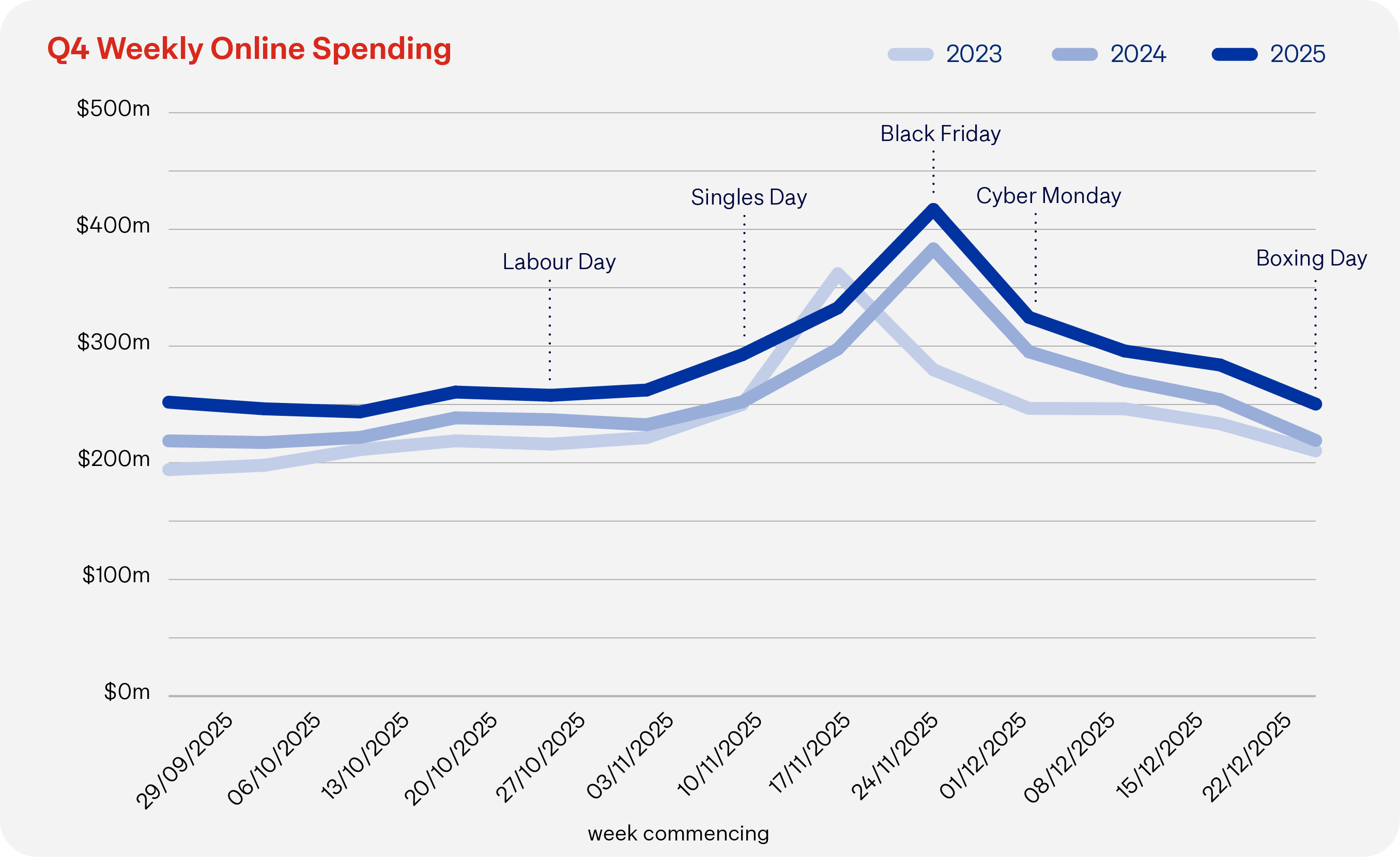
Beyond how and where Kiwi shoppers spent, the other big shift was to when they spend. Online demand was concentrated around the major November promotional events –particularly Black Friday-Cyber Monday – before declining through December. In-store shopping strengthened closer to Christmas as shoppers prioritised immediacy and certainty. As a result, Peak success for omnichannel retailers is no longer about planning for a big shopping moment but for a promotion-driven online peak in November, followed by a convenience-driven in-store surge in December.
Peak 2025: The big numbers
Q4 2025 (vs Q4 2024)
Peak 2025 delivered a strong result for online retail. Spending and transactions both increased by 11%, while average basket size remained about the same.
Online spending
Online spending $3.77b▲ 11% | Online transactions 30.7m▲ 11% | Average basket size $123
|
By comparison, in-store spending grew by just 2%, driven by a 1% increase in transactions. At $56, the average in-store basket size is significantly less than online. And while in-store still drives the bulk of retail spending, online continues to grow at a much faster rate, making up 23.4% of total retail in Q4 2025.
Singles’ Day 2025
Singles’ Day delivered the fastest year-on-year growth of the major Peak events. Online spending rose 42%, driven by a 36% increase in transactions. In-store spending was also strong (+15%), although online grew almost three times faster.
Singles’ Day 2025 (vs 2024)
Online spending $48.8m▲ 42% | Online transactions 0.4m▲ 36% | Average basket size $122
|
Black Friday - Cyber Monday 2025
The four days from Black Friday to Cyber Monday were the standout online moment of Peak 2025. Online spending reached almost a quarter of a billion dollars – up 10% on the year before – driven by over 130,000 more (+8%) transactions over the four days. In-store spending over the period grew by just 2%.
Black Friday – Cyber Monday 2025 (vs 2024)
Online spending $248.3m▲ 10% | Online transactions 1.8m▲ 8% | Average basket size $138
|
Boxing Day 2025
Boxing Day spending and transactions declined on 2024 across both online and in-store. While Boxing Day continued to attract high-value purchases – with an average online basket of $142 – it did not reach the highs of 2024. In-store Boxing Day spending was down 3% and transactions down 1%.
Boxing Day 2025 (vs 2024)
Online spending $46.5m▼ 1% | Online transactions 0.33m▼ 2% | Average basket size $142
|
Four insights from Peak 2025
Insight 1: Online and in-store shoppers follow different Peak timelines
Peak demand no longer follows a single curve. In 2025, online spending built through the November promotional period, peaked on Black Friday–Cyber Monday and then gradually declined through December. In-store shopping followed a different pattern. Physical stores became more important through December as shoppers prioritised immediacy and certainty, with the ability to see, buy and take an item home became increasingly valuable as the delivery window narrowed.
The contrast reflects the different roles each channel plays. Online helps shoppers research, compare and act on promotional offers ahead of time. In-store becomes more important when speed, product certainty and last-minute convenience are priority.
What this means for you
Omnichannel retailers should plan marketing, stock and staffing for Peak as two related but distinct customer journeys: a promotion-led online phase in November and a convenience-led in-store phase closer to Christmas. Clear delivery cut-off dates, accurate stock visibility and options such as click and collect can also help connect the two phases and retain customers as their priorities change.
Insight 2: Black Friday is reshaping the Peak season
Black Friday-Cyber Monday has moved from being a standalone promotion to becoming the central eCommerce event of Peak. In 2025, online spending across the four-day weekend was up 10%, compared to just 2% in the same period for in-store. This reinforces the importance of this long-weekend in driving eCommerce demand. But its influence extends beyond the four days themselves. Shoppers now research deals earlier, monitor prices and bring forward purchases that might once have happened in December or on Boxing Day. And with an online average basket size of $138 ($15 more than the Q4 average), shoppers used the weekend for more considered higher-value purchases, not just deal-driven buying.
Singles’ Day remains smaller than Black Friday–Cyber Monday, but its strong growth shows it is becoming a more established part of New Zealand’s promotional calendar. Its 42% lift in online spending suggests shoppers are ready to begin Peak buying well before Black Friday.
What this means for you
The opportunity is to treat Black Friday as the core of a structured Peak plan. Inventory, website performance, marketing and fulfilment capacity should be ready before November, and ideally in time to capitalise on increasing interest around Singles’ Day.
Insight 3: Online growth is driven by greater transaction frequency, not basket size.
Online spending grew five times faster than in-store. As a result, eCommerce’s share of retail spending increased from just over one in five retail dollars to almost one in four.
Growth was driven by transaction volume rather than a significant change in average basket size. This points to a familiar trend: Kiwis are switching to shopping online more often, rather than simply spending substantially more each time they purchase.
What this means for you
Focus on increasing frequency and customer lifetime value, not just one large Peak order. Make it easy for customers to return through saved details, simple reordering, personalised follow-up and loyalty rewards. Review the full journey from product discovery to delivery and returns. A seamless experience during Peak can turn a promotion-led first purchase into an ongoing customer relationship.
Insight 4: Local retailers strengthened their position
New Zealand-based retailers captured 79.3% of online spending during Q4 2025.
Kiwi shoppers continue to value faster and more predictable delivery, easy returns, trustworthy service and the reassurance of dealing with a retailer that has a visible local presence. These strengths become especially valuable during Peak. As Christmas approaches, the consequences of a missed delivery or difficult return become greater. Local fulfilment capability, accurate delivery expectations and responsive customer service can therefore be as influential as price.
What this means for you
Make the local advantage visible at every step. Clearly communicate where stock is held, delivery timeframes, Christmas cut-offs, returns processes and customer support options. Use trusted delivery partners and proactive tracking to provide certainty. Local retailers have a strong position heading into Peak 2026, but converting that advantage into loyalty depends on consistently delivering the experience customers expect.
How to prepare for Peak 2026
1. Plan for two Peak phases
Prepare for an online peak in November, followed by an in-store surge before Christmas. Align marketing, inventory, staffing and fulfilment with these different shopping patterns, while using options such as click and collect to connect the two phases.
2. Be ready when demand arrives
Singles’ Day is growing and Black Friday–Cyber Monday is now the height of Peak. Confirm stock and delivery capacity early, and test your website, checkout and customer-service processes before promotions begin.
3. Deliver value beyond discounting
Value is about more than the lowest price. Quality, useful bundles, loyalty rewards, local craftsmanship, delivery certainty and easy returns can all strengthen your offer without eroding margins. Discover more about what Kiwi shoppers value in our latest Market Sentiments 2026 Report.
4. Reinforce trust and transparency
Make your local presence, contact details, product information, delivery partner and returns policy easy to find. Clearly communicate delivery costs, timeframes and cut-off times, then provide proactive tracking updates. These visible trust signals offer reassurance when shoppers are increasingly alert to scams. Explore the importance of trust in our latest Market Sentiments 2026 Report.
5. Create a great customer experience
Remove friction from product discovery through to delivery and returns. Offer a fast mobile experience, flexible payment and delivery choices, responsive support and straightforward returns. A seamless website-to-doorstep journey can turn a Peak purchase into a lasting customer relationship.
The final word
The Peak season is becoming more concentrated, more digital and more competitive.
Black Friday-Cyber Monday has firmly established itself as the biggest eCommerce moment of the year, while online and in-store shoppers increasingly follow different paths through the season. At the same time, online continues to gain share and local retailers are strengthening their competitive position.
For Peak 2026, success will depend less on reacting to demand and more on anticipating it. Retailers that prepare early, align marketing and fulfilment with changing shopping behaviours, and deliver a seamless customer experience across every touchpoint will be best placed to capture growth when demand peaks.
This report is published for general information purposes only. The views and opinions expressed, and any advice provided, is general in nature only. NZ Post does not represent that any information or advice it contains is suitable for your circumstances or purposes.
The data used in this eCommerce Spotlight is transactional data supplied by Dot Loves Data. We are continually reviewing and refining our methodology to bring our readers the most relevant and accurate information possible. At times, as we update our approach, this creates some discrepancies with previously published information. While we don’t go back and adjust earlier published information, when comparing current information with past periods we use consistent like-for-like methodology.